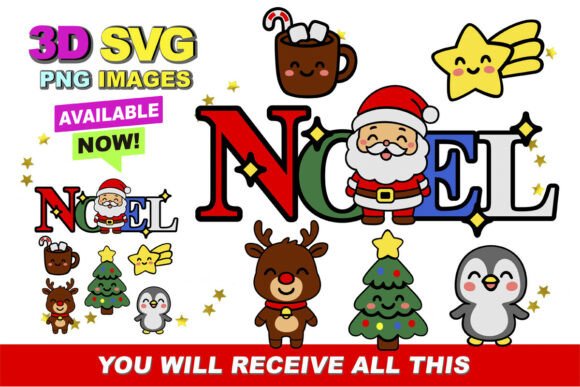
Christmas NOEL 3D SVG: Design & Cut
The holiday season demands a specific kind of visual language, one that balances tradition with the desire for something fresh and tactile. For creators who rely on digital tools to bring physical projects to life, the quality of the source file is often the deciding factor between a flat, forgettable decoration and a standout piece that captures attention. The Christmas NOEL 3D SVG format offers a distinct advantage in this regard by introducing depth and dimensionality into designs that are traditionally two-dimensional. Unlike standard vector files that rely solely on outlines, a 3D-style SVG utilizes layering, shading techniques, and perspective tricks within the vector code itself to simulate volume. This approach transforms simple text or icons into assets that appear to pop off the page, adding immediate visual weight and interest to any project.
Accessibility plays a crucial role in the creative workflow, especially when deadlines loom during the busy winter months. When you download this asset, it arrives easily accessible in a neat, zipped folder. This organization is not merely about tidiness; it represents a streamlined workflow where every necessary component is accounted for. Inside, you will find the primary design layers, separate color elements, and sometimes bonus variations, all structured logically to prevent the frustration of hunting through scattered files. This level of preparation allows professionals and hobbyists alike to move from concept to execution without administrative friction, ensuring that time is spent on crafting rather than file management.
Seamless Integration with Leading Cutting Software
The true utility of a digital asset lies in its compatibility with the hardware and software ecosystem you already own. One of the most significant strengths of this Christmas NOEL 3D SVG is its effortless trimmability on industry-standard platforms like Silhouette Studio and Cricut Design Space. These applications have become the backbone of modern DIY and small-scale manufacturing, yet they can sometimes struggle with complex, poorly constructed vector files. A well-optimized 3D SVG resolves these issues by ensuring that nodes are clean, paths are closed, and layers are logically grouped.
When working in Silhouette Studio, the ability to import a file that immediately recognizes cut lines versus print-and-cut boundaries is invaluable. With this specific design, the 3D effect is achieved through distinct layers that the software interprets correctly. You do not need to spend hours ungrouping elements or tracing over messy lines. Instead, you can focus on arranging the "NOEL" text and accompanying decorative elements, adjusting the scale, and selecting your materials. Similarly, Cricut Design Space users benefit from a file structure that adheres to the platform's requirements for welding, attaching, and contouring. This compatibility means that the intricate details required to create a 3D illusion remain intact during the cutting process, resulting in crisp edges and precise alignment when the pieces are assembled.
Expanding Creative Horizons Beyond Standard Tools
While the primary target audience includes users of Silhouette and Cricut machines, the versatility of the SVG format extends further. If your creativity flows through a different type of machine, such as a laser cutter, vinyl plotter, or even a professional large-format printer, it is essential to ascertain its compatibility with this distinct file format. The SVG (Scalable Vector Graphics) standard is widely supported across the graphic design and fabrication industry because it uses mathematical equations to define shapes, allowing for infinite scaling without loss of quality. However, the specific rendering of 3D effects—such as drop shadows or gradient fills used to simulate depth—may require slight adjustments depending on the capabilities of your specific device.
For instance, a laser cutter might interpret the darker shaded areas of a 3D SVG differently than a vinyl cutter. In some cases, you may need to convert certain visual effects into actual cut lines or adjust the power settings to achieve the desired texture. Conversely, for screen printing or heat transfer applications, the layered nature of the file allows for easy separation of colors, enabling multi-pass printing that enhances the three-dimensional look. By understanding how your specific equipment interacts with vector data, you can adapt the Christmas NOEL 3D SVG to fit a wider range of production methods, from custom apparel to architectural signage.
Practical Applications for Professionals and Hobbyists
The value of this design resource extends beyond simple decoration; it serves as a functional tool for various professional and personal goals. For small business owners selling handmade goods, the ability to offer products with a premium, dimensional aesthetic can significantly increase perceived value. A greeting card featuring a flat "NOEL" font competes in a crowded market, but one utilizing the depth and shadow play of a 3D SVG stands out on a retail shelf. This visual distinction can drive sales and strengthen brand identity, suggesting a higher level of craftsmanship and attention to detail.
Marketing professionals and bloggers can also leverage these assets to enhance their content strategy. High-quality, original graphics are essential for social media engagement, particularly during the holiday season when competition for attention is fierce. Using a Christmas NOEL 3D SVG to create headers, promotional banners, or downloadable resources for followers provides a cohesive and polished look that aligns with current design trends. The file's scalability ensures that the image looks sharp whether it is displayed on a mobile screen or printed as a large poster for an event.
Educators and workshop leaders find these files equally useful for teaching design principles and technical skills. Because the file is organized in a neat, zipped folder with clear layers, it serves as an excellent case study for students learning about vector manipulation, layer management, and the relationship between digital design and physical output. Students can experiment with modifying the 3D effects, changing colors, or rearranging elements to understand how digital choices impact the final product.
Efficiency and Decision Simplification
In a landscape saturated with free, low-quality clip art, finding a reliable resource can be a time-consuming ordeal. The Christmas NOEL 3D SVG simplifies decision-making by offering a proven, high-quality solution that eliminates the guesswork. Creators no longer need to waste hours searching for images that might be pixelated upon zooming or riddled with errors that cause cutting machines to malfunction. The assurance that the file is effortlessly trimmable on major platforms reduces the risk of project failure and material waste. This reliability translates directly into cost savings and increased productivity, allowing creators to focus their energy on innovation rather than troubleshooting.
Furthermore, the organized delivery method supports a more efficient workflow. When files are pre-sorted and labeled, the transition from planning to production is seamless. This is particularly beneficial for entrepreneurs managing multiple projects simultaneously. The ability to quickly access the correct layer for a specific task—such as isolating the outline for a stencil or the full design for a decal—streamlines the entire creation process. It empowers users to execute their vision with confidence, knowing that the foundational digital asset is robust and ready for use.
Considerations for Optimal Results
While the Christmas NOEL 3D SVG offers numerous advantages, it is important to approach its use with realistic expectations regarding material limitations. The 3D effect relies heavily on the interplay of light, shadow, and layering. When translating this to physical materials, the choice of substrate matters. For example, using a glossy vinyl might enhance the reflective qualities of the design, while a matte finish could soften the contrast. Additionally, if the design involves very fine lines or tiny details intended to create depth, users should consider the blade condition and cutting speed of their machine to ensure clean cuts without tearing delicate sections.
It is also worth noting that while the file is optimized for Silhouette and Cricut, other software may render the 3D effects slightly differently. Users working outside these ecosystems should always preview the design in their specific application before committing to a cut or print run. Testing on scrap material is a prudent step to verify that the layers align correctly and that the intended visual impact is achieved. By taking these practical steps, creators can maximize the potential of the file and ensure that their final projects meet the highest standards of quality and professionalism.