Evaluating the 3D Gingerbread House Accordion Card for Holiday Crafting
The holiday season often brings a desire to create personalized, tangible tokens of affection for friends and family. Among the myriad of paper crafting options available, the 3D Gingerbread House Accordion Card has emerged as a popular choice for both novice and experienced crafters. This digital design bundle offers a structured approach to creating intricate, dimensional greeting cards that stand out from traditional flat stationery. Understanding the components, requirements, and practical applications of this project is essential for determining whether it aligns with your crafting goals and skill level.
Understanding the Design and Structure
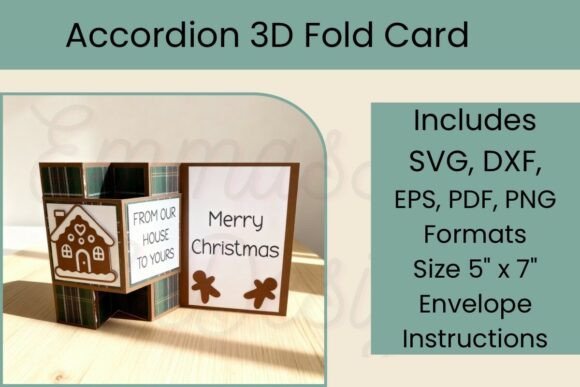
At its core, the 3D Gingerbread House Accordion Card is a layered paper engineering project. Unlike standard cards that fold once, an accordion fold creates multiple panels that expand and contract, allowing for a narrative or scenic display. The "gingerbread house" theme utilizes die-cut layers to simulate depth, shadow, and texture, mimicking the look of a decorated confectionary structure. The design typically includes a central focal point—the house—surrounded by complementary elements such as a gingerbread man, snowflakes, or winter foliage.
The term "digital bundle" indicates that the product is not a physical kit but a set of computer files. These files are designed specifically for use with electronic cutting machines, such as Cricut, Silhouette, or Brother ScanNCut devices. The inclusion of various file formats ensures compatibility across different software ecosystems. For instance, SVG files are ideal for users of Cricut Design Space or Silhouette Studio Designer Edition, while DXF files cater to those using the basic version of Silhouette Studio. EPS files serve vector-based programs like Adobe Illustrator, and PNGs provide high-resolution images for those who may prefer printing rather than cutting.
Why Crafters Choose This Project
There are several compelling reasons why individuals seek out this specific type of card design. Primarily, it offers a professional aesthetic without requiring advanced artistic drawing skills. The digital templates handle the complex geometry, allowing the crafter to focus on assembly and material selection. This democratization of design enables hobbyists to produce cards that resemble boutique stationery, often perceived as higher value than mass-produced alternatives.
Furthermore, the modular nature of the accordion fold provides versatility. It can serve as a standalone greeting card, a small tabletop decoration, or even a component in a larger scrapbook layout. For educators and parents, the simplified versions of these designs can function as engaging kids’ Christmas craft projects, teaching spatial reasoning and fine motor skills through paper manipulation. The tactile experience of opening an accordion card adds an element of surprise and interaction that flat cards lack, enhancing the recipient's engagement with the gift.
Benefits and Practical Advantages
One significant advantage of using a digital bundle for a 3D Gingerbread House Accordion Card is cost efficiency over time. Once purchased, the files can be used repeatedly to create multiple cards. This makes the investment particularly attractive for those planning to make gifts for teachers, neighbors, or extended family members. Additionally, the ability to customize materials means crafters can control the final look entirely. You might choose classic kraft paper for a rustic feel, glossy cardstock for a vibrant pop, or patterned scrapbook paper for added visual interest.
The layered 3D effect also contributes to the card’s longevity as a keepsake. Because these cards often possess structural integrity and decorative appeal, recipients are more likely to display them as holiday decor rather than discarding them after reading the message. This transforms the card from a transient communication tool into a lasting memento of the season.
Considerations and Tradeoffs
Despite its advantages, this project is not without its challenges. The primary consideration is the time commitment. Assembling a multi-layered 3D card requires patience and precision. Each layer must be aligned correctly to maintain the intended depth and perspective. For beginners, this process can be daunting, and rushing the assembly may result in a skewed or unstable structure. It is important to set realistic expectations regarding production speed; these are not last-minute projects.
Another tradeoff involves material costs. While the digital file is a one-time expense, the physical supplies—high-quality cardstock, adhesives, and potentially embellishments like glitter or ribbon—can accumulate. Achieving the "professional finish" mentioned in product descriptions often requires premium materials that hold their shape well under the stress of folding and layering. Thin or low-quality paper may warp or fail to support the weight of upper layers, compromising the 3D effect.
Additionally, technical proficiency with cutting machines is necessary. Users must understand how to upload files, adjust cut settings for different materials, and troubleshoot potential issues like incomplete cuts or blade drag. Those without access to a cutting machine may find the project less accessible, although the included PDF templates offer a manual cutting alternative for those willing to invest the extra effort.
Ideal Use Cases
This design is a strong fit for several specific scenarios. It is excellent for craft fair vendors looking to add unique, high-perceived-value items to their market stall collections. The intricate appearance justifies a higher price point compared to simple flat cards. It is also suitable for individuals who enjoy the meditative aspect of crafting and have the time to dedicate to detailed assembly. If your goal is to create a memorable impression on close friends or family members who appreciate handmade efforts, this card serves as an impactful gesture.
For educators, the design can be adapted for classroom activities during the holiday season, provided the complexity is adjusted for the age group. Older students may benefit from the engineering aspects of the accordion fold, while younger children might focus on decorating pre-cut elements.
When to Consider Alternatives
However, there are situations where alternative projects may be more appropriate. If you are looking for a quick, bulk solution for holiday greetings, a simpler flat card design or a printed photo card would be more efficient. The labor-intensive nature of the 3D accordion card makes it impractical for large distribution lists unless you have significant lead time.
Similarly, if you do not own a cutting machine and are uncomfortable with precise hand-cutting using scissors or craft knives, this project may cause frustration. In such cases, pre-made card kits or digital printable cards that require no assembly might better suit your needs. Additionally, if postal costs are a concern, the thickness and rigidity of a 3D card may require additional postage or protective packaging, which should be factored into your budget.
Making the Decision
Choosing to create a 3D Gingerbread House Accordion Card ultimately depends on your balance of time, skill, and desired outcome. If you value uniqueness, enjoy the process of assembly, and have access to the necessary tools, this digital bundle offers a rewarding creative outlet. It bridges the gap between amateur crafting and professional design, providing a structured path to creating impressive holiday artifacts. By carefully considering the material requirements and time investment, you can ensure that the final product meets your expectations and brings joy to both the creator and the recipient.