3D Hanging Butterfly Laser Cut: A Strategic Approach to Decorative Production
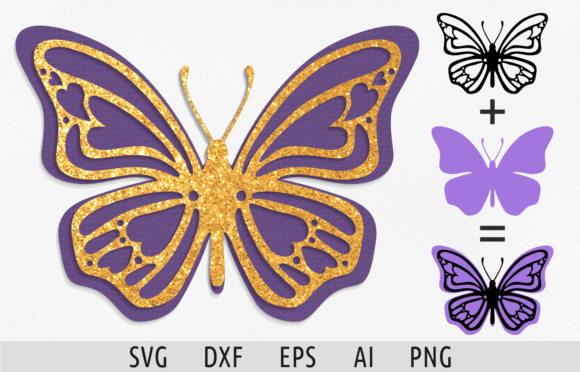
For makers, small business owners, and design professionals, the 3D Hanging Butterfly Laser Cut represents more than a simple craft project; it is a versatile asset for product development, brand positioning, and efficient manufacturing. This layered design, optimized for 3 mm plywood, MDF, or acrylic, offers a subtle dimensional effect that elevates standard flat cuts into sophisticated wall art, ornaments, and gift accents. By integrating a ready-to-cut hanging hole and providing multiple size variations, this file format streamlines the production workflow, allowing creators to focus on finishing techniques and market application rather than troubleshooting complex assembly.
The strategic value of this specific design lies in its balance between aesthetic appeal and operational simplicity. In an industry where time-to-market and material efficiency dictate profitability, a clean, optimized file reduces waste and machine runtime. Whether you are a hobbyist exploring new revenue streams or a professional laser shop scaling your inventory, understanding how to deploy the 3D Hanging Butterfly Laser Cut intentionally can significantly impact your creative output and commercial success.
Optimizing Workflow with Layered Design Principles
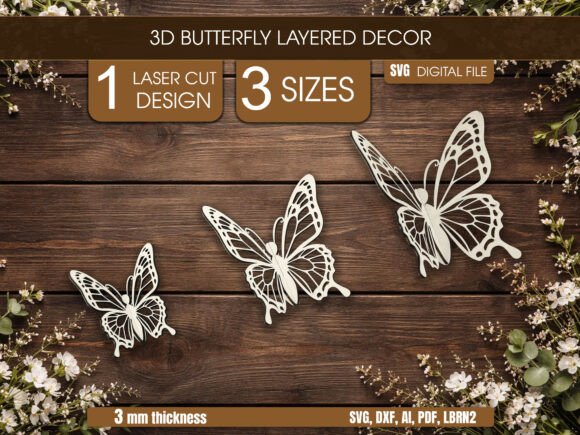
Effective production begins with selecting assets that align with your equipment capabilities and material constraints. The 3D Hanging Butterfly Laser Cut is engineered specifically for 3 mm materials, a thickness that provides structural integrity while remaining lightweight enough for suspension. This specification is critical for decision-makers who must manage material costs and shipping logistics. Using a design calibrated for this thickness ensures smooth cutting paths, minimizing the risk of burning edges or misalignment during the nesting process.
The inclusion of three distinct size variations—90 mm, 140 mm, and 170 mm width—facilitates strategic planning for diverse product lines. A single design file that scales effectively allows a business to offer tiered pricing options without investing in additional design time. For instance, the 90 mm version serves as an ideal tag or small accent piece, while the 170 mm variant commands attention as a standalone wall sculpture. This scalability supports a modular approach to inventory management, enabling sellers to test different market segments with a unified visual identity.
Furthermore, the provision of multiple file formats (SVG, DXF, AI, PDF, LBRN2) ensures compatibility across various software ecosystems. This technical flexibility reduces friction in the pre-production phase. Operators can import the vector data directly into their preferred control software, ensuring that the black lines designated for cutting are interpreted correctly. This level of optimization is essential for maintaining high throughput in a competitive environment, where every minute saved on setup translates to increased capacity.
Material Selection and Finishing Strategies
The true potential of the 3D Hanging Butterfly Laser Cut is unlocked through deliberate material selection and finishing techniques. While the design works well on natural wood, the choice of substrate dictates the final aesthetic and target demographic. Plywood offers a warm, organic texture suitable for rustic or Scandinavian interior styles, whereas MDF provides a smooth, uniform surface ideal for painting. Acrylic introduces a modern, translucent quality that plays with light differently, creating depth through refraction rather than shadow.
Strategic finishing transforms a raw cut into a premium product. Consider the following approaches to maximize perceived value:
- Acrylic Paints: These allow for vibrant color matching, making the butterfly suitable for themed nursery decor or seasonal collections. The layered nature of the design creates natural shadow lines that enhance the painted finish.
- Metallic Finishes: Applying gold, silver, or copper leaf or spray paint elevates the piece into a luxury category, perfect for wedding favors or high-end home accents.
- Wood Stain: For a minimalist approach, staining the layers before assembly highlights the grain and maintains a natural look, appealing to eco-conscious consumers.
- Glitter and Pastels: These finishes cater to specific niches, such as children's rooms or festive holiday markets, adding texture and visual interest.
Decision-makers should view these finishing options not merely as decoration but as branding tools. Consistency in finish across a product line reinforces brand recognition. If a seller positions themselves as a purveyor of elegant, understated decor, a metallic or stained finish aligns with that narrative better than a chaotic mix of glitter and bright colors. The versatility of the 3D Hanging Butterfly Laser Cut allows for experimentation, but long-term success requires a cohesive strategy regarding how these elements are presented to the customer.
Market Positioning and Product Application
Understanding the end-use scenario is vital for maximizing the return on investment for any laser-cut project. The 3D Hanging Butterfly Laser Cut is uniquely positioned to serve multiple functions due to its integrated hanging hole. This feature eliminates the need for secondary hardware installation, simplifying the user experience and reducing packaging complexity.
In the context of home decor, the butterfly acts as a focal point for walls, particularly in nurseries, living rooms, or entryways. Its layered construction creates a dynamic visual that changes with the lighting throughout the day, offering a level of sophistication that flat decals cannot achieve. For entrepreneurs targeting the gifting sector, the design's portability and elegance make it an excellent candidate for wedding invitations, party favors, or corporate gifts. The ability to customize the size and finish allows for personalization at scale, a key driver in the modern gifting economy.
Small businesses and craft fair sellers can leverage this design to create "impulse buy" items. The 90 mm version, for example, is compact enough to be sold as a decorative tag attached to a larger product, increasing the average order value. Alternatively, it can be packaged as a standalone ornament. By analyzing local market trends and seasonal demands, producers can adjust their production schedule to prioritize specific sizes or finishes, ensuring that inventory turnover remains high.
Risk Management and Intentional Execution
While the 3D Hanging Butterfly Laser Cut offers significant advantages, relying on it without a clear strategic framework carries risks. One common pitfall is overproduction based on the assumption of universal appeal. Without testing the market response to specific finishes or sizes, a maker may find themselves with excess inventory that does not align with current consumer preferences. It is crucial to treat the initial production run as a data-gathering exercise, using sales feedback to refine future batches.
Another risk involves the dilution of brand identity. Because the design is highly adaptable, there is a temptation to produce every possible variation simultaneously. However, a scattered portfolio often confuses customers and weakens marketing messages. A more effective approach is to curate a limited collection that tells a coherent story. For example, focusing exclusively on natural wood stains for a "Forest Theme" collection creates a stronger market position than offering a disjointed array of glittery butterflies alongside stained ones.
Additionally, operators must consider the limitations of their equipment. While the file is optimized for 3 mm material, attempting to use thicker substrates without adjusting the design parameters can lead to poor cut quality and wasted material. Similarly, neglecting to account for kerf—the width of the laser beam—can result in parts that do not fit together snugly, compromising the dimensional effect. Technical diligence is just as important as creative vision when executing a project of this nature.
Long-Term Value and Scalability
The enduring value of the 3D Hanging Butterfly Laser Cut lies in its adaptability and the efficiency it brings to the production pipeline. As a digital asset, the file can be reused indefinitely, amortizing the initial cost over thousands of units. This makes it an attractive option for businesses looking to expand their catalog without incurring recurring design fees. Over time, successful iterations of this product can evolve into signature pieces that define a brand's aesthetic.
For educators and mentors teaching laser cutting, this design serves as an excellent pedagogical tool. It demonstrates fundamental principles of nesting, layering, and finishing in a way that yields immediate, tangible results. Students can learn about material properties, machine calibration, and market analysis by working through the entire lifecycle of the product, from file preparation to final sale.
Ultimately, the success of any project hinges on intentionality. The 3D Hanging Butterfly Laser Cut is a powerful resource, but its impact is determined by how thoughtfully it is applied. By aligning the design's features with clear business goals, selecting materials that resonate with the target audience, and maintaining rigorous quality control, creators can transform a simple vector file into a cornerstone of their creative enterprise. Whether used to decorate a home, launch a new product line, or teach a valuable skill, the strategic deployment of this design ensures that every cut contributes to meaningful outcomes.